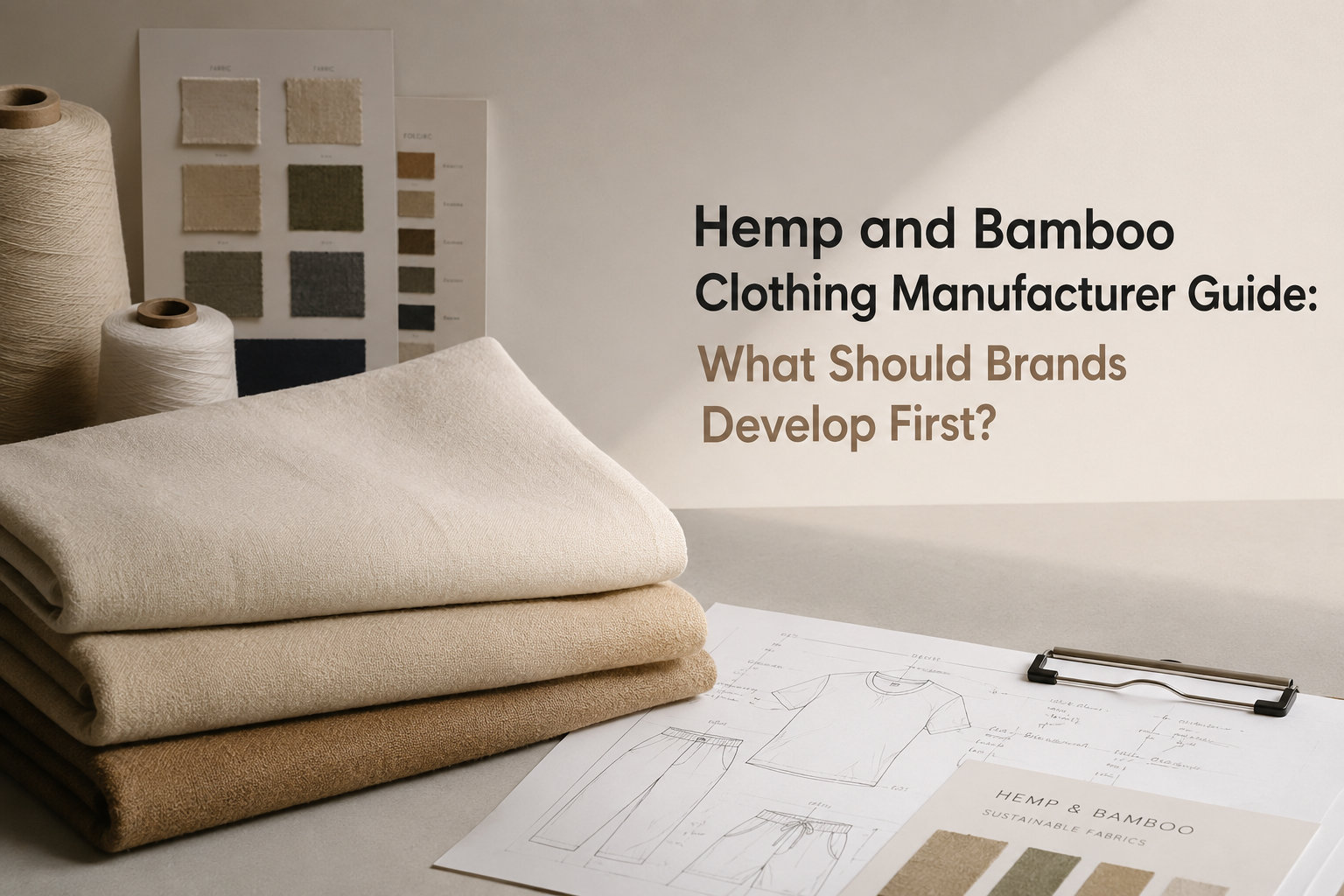
Adult basics may look simple, but producing them consistently is not simple. A good T-shirt, hoodie, tank top, or jogger still depends on fabric sourcing, GSM, fit, labels, packaging, quality control, and repeat production. For clothing brands, choosing the right manufacturer is less about finding a factory that can sew a basic garment and more about finding one that can repeat the same standard order after order.
To choose a sustainable clothing manufacturer for adult basics, first check whether the factory can make the exact product types you need. Then confirm practical fabric options such as bamboo cotton, organic cotton, cotton spandex, rib, jersey, French terry, and fleece. Ask about MOQ, sample time, bulk production time, measurement tolerance, labels, packaging, QC, and repeat-order stability. A reliable manufacturer should understand both simple garment construction and long-term consistency. For adult basics, stable fabric, fit, sizing, sewing, and communication are often more important than complicated design capability.
This guide helps brands compare manufacturers before sampling custom T-shirts, hoodies, joggers, tank tops, sweatshirts, and other repeatable adult basics.
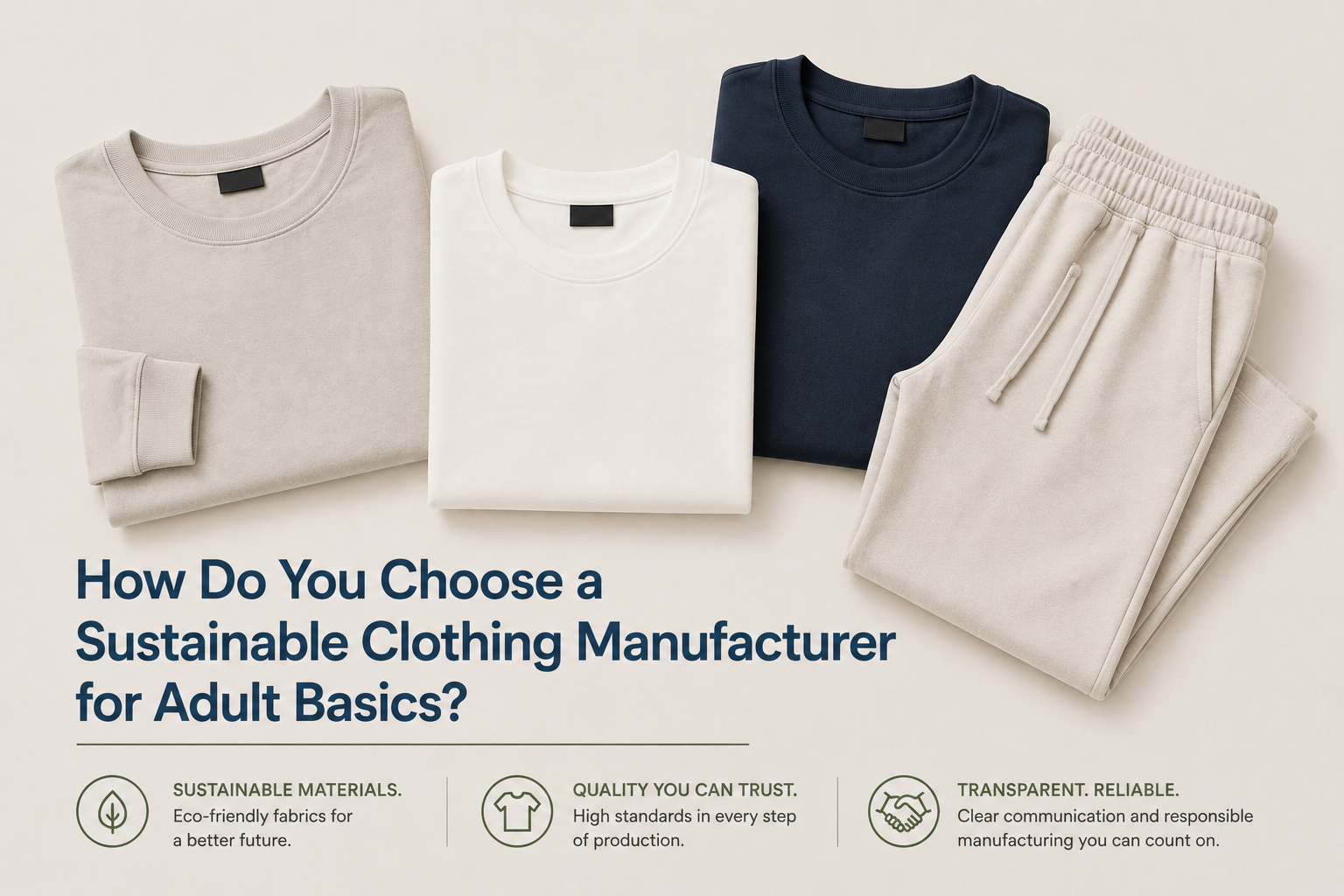
How Do You Choose a Sustainable Clothing Manufacturer for Adult Basics?
What Types of Adult Basics Should a Manufacturer Be Able to Make?
A manufacturer for adult basics should be able to develop simple, repeatable products such as T-shirts, long sleeve tops, tanks, sweatshirts, hoodies, joggers, and basic shirts with stable fit and production quality.
A manufacturer does not need to make every garment category to be a good partner for an adult basics brand.
In fact, specialization can be useful.
A practical adult basics manufacturer should normally be comfortable developing products such as:
- short sleeve T-shirts
- long sleeve T-shirts
- tank tops
- rib tops
- crewneck sweatshirts
- pullover hoodies
- zip hoodies
- joggers
- simple lounge sets
- basic casual shirts
- waffle long sleeve tops
These products may look simple compared with tailored jackets or highly structured fashion pieces, but basics have their own production challenges.
The difficulty is usually not complicated construction. It is consistency.
For example, a basic T-shirt needs:
- stable neckline shape
- controlled shrinkage
- consistent body length
- clean shoulder seams
- limited side-seam twisting
- repeatable fabric hand feel
- consistent print placement
A hoodie needs additional control over:
- hood shape
- rib recovery
- cuff tension
- pocket placement
- drawcords
- shrinkage
- fabric weight
Joggers need stable waistbands, correct rise, pocket construction, cuff recovery, and consistent leg shape.
That is why brands should ask a potential manufacturer to show experience in the actual basics they want to develop rather than only asking, “Can you make clothing?”
Brands developing matching bottoms can review custom joggers, while sweatshirt-led collections can also explore custom hoodies.
Why Should Brands Check Fabric Sourcing First?
Fabric is the foundation of adult basics, so brands should choose a manufacturer that can explain practical fabric options instead of simply offering the cheapest material.
For simple garments, fabric often determines more of the final product experience than the pattern itself.
A manufacturer should be able to help brands compare practical options such as:
- bamboo cotton
- organic cotton
- cotton spandex
- cotton modal
- rib
- jersey
- French terry
- brushed fleece
- waffle
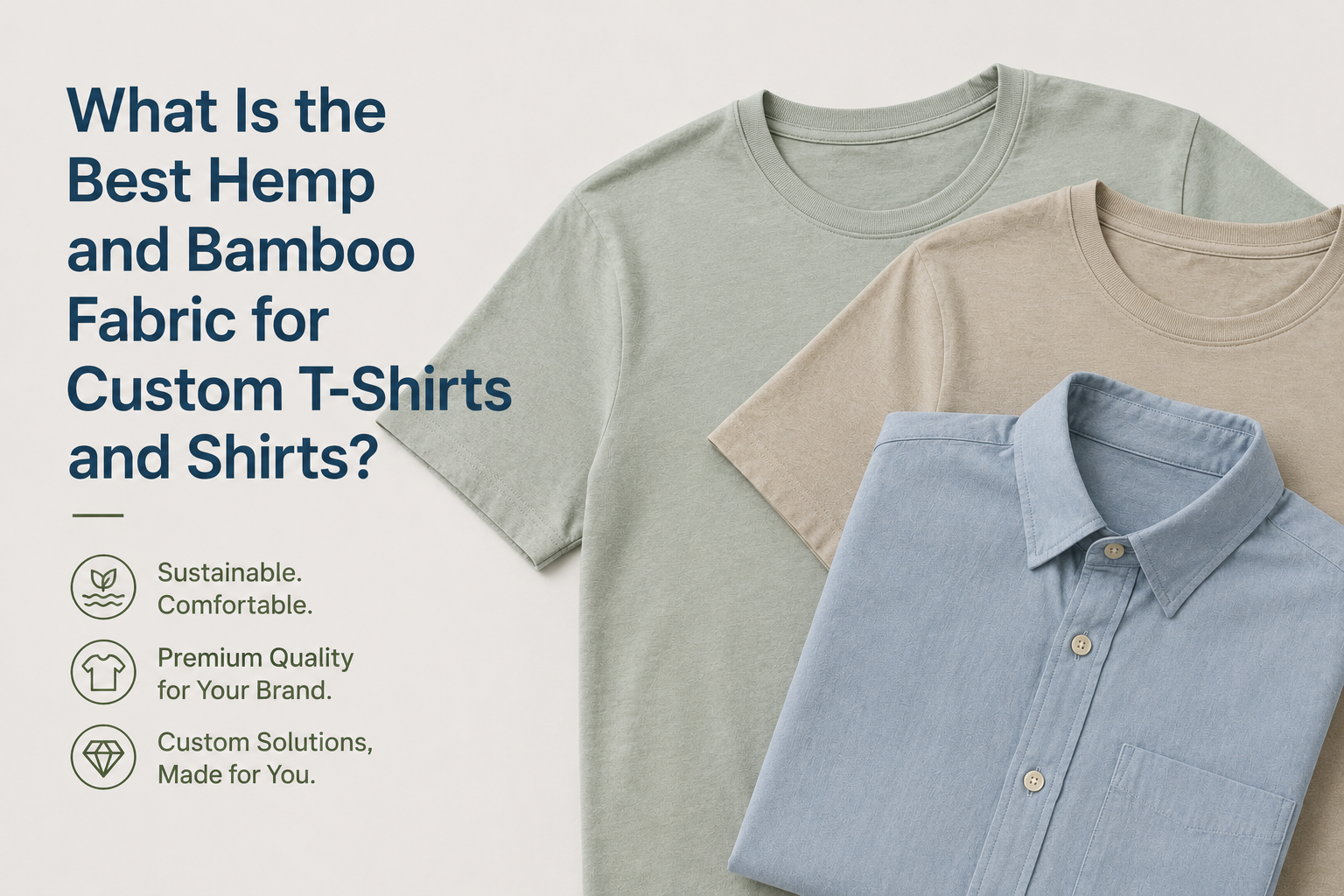
Bamboo cotton
Bamboo-derived fiber and cotton blends can work well for softer T-shirts, relaxed tops, and comfort-focused basics.
However, brands should confirm the actual fiber description. In some markets, especially the United States, rayon or viscose made from bamboo needs accurate labeling rather than simply being described as “bamboo.”
Organic cotton
Organic cotton can work well for:
- premium T-shirts
- sweatshirts
- hoodies
- joggers
- everyday basics
It is familiar to consumers and relatively easy to use across different garment categories. If certification matters, the brand should still confirm the certificate scope and supporting supplier documents.
Cotton spandex
A small percentage of spandex may improve:
- stretch
- recovery
- fitted comfort
- neckline or body recovery
This can be useful for tank tops, fitted tees, rib tops, and flexible everyday basics.
Cotton modal
Cotton-modal blends can give a softer, smoother hand feel and more fluid drape. They may suit premium T-shirts, soft tops, and lightweight comfort basics.
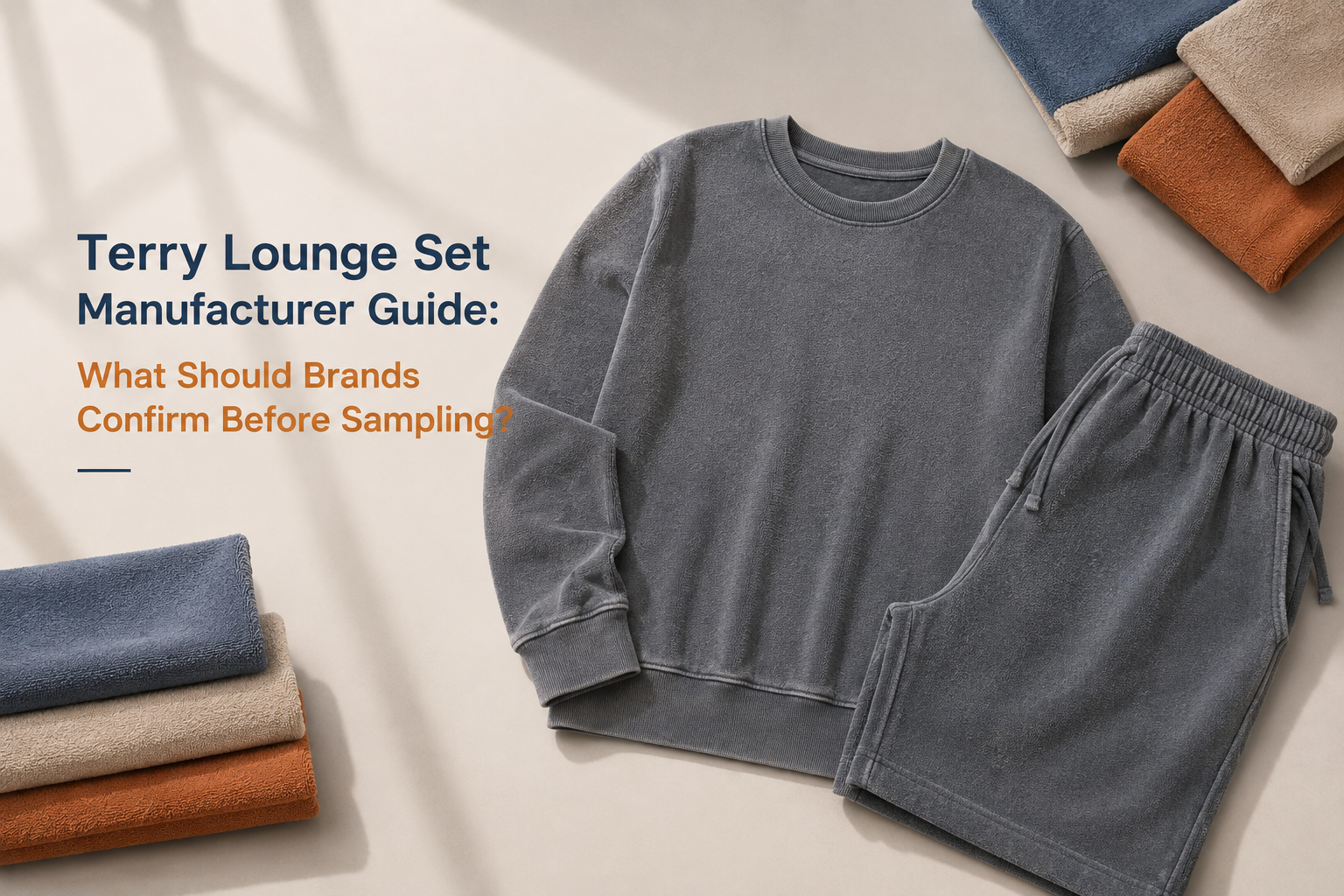
French terry and brushed fleece
These are practical options for:
- hoodies
- crewneck sweatshirts
- joggers
- matching sets
French terry is usually more breathable and transitional, while brushed fleece is usually warmer.
Hemp
Hemp can still be useful when a brand wants natural texture or a more premium fabric story. However, hemp can cost more, so many commercially focused brands choose bamboo cotton, organic cotton, or balanced blends when they need easier cost control and repeat ordering.
The important question is not:
“Which fabric sounds most sustainable?”
It is:
“Which fabric matches our product, target price, market, and production plan?”
For a broader comparison, read best sustainable fabrics for clothing brands.
What Should Startup Brands Ask Before Sampling?
Startup brands should prepare clear product references, fabric direction, sizes, branding, quantity expectations, and launch timing before asking a manufacturer to make the first sample.
A startup does not always need a perfect tech pack on day one.
However, the manufacturer still needs enough information to understand what the founder is trying to build.
A useful pre-sampling checklist includes:
- product type
- reference images
- target customer
- target fabric hand feel
- fabric composition
- GSM
- color
- size range
- logo position
- print or embroidery method
- label type
- packaging
- MOQ
- sample cost
- sample time
- bulk production timeline
- shipping destination
Reference images are particularly useful when the founder does not yet have detailed technical drawings.
But an image alone is not enough.
For example, if you send a picture of an oversized T-shirt, the manufacturer still needs to understand:
- how oversized it should be
- target GSM
- fabric composition
- neckline width
- shoulder drop
- body length
- sleeve length
- expected size range
A good manufacturer can help organize these decisions into a clearer sample direction before production.
New brands should also avoid developing too many SKUs at once.
One to three focused products are normally easier to:
- sample
- correct
- photograph
- launch
- test in the market
- reorder
A startup might begin with:
- one core T-shirt
- one long sleeve version
- one sweatshirt or hoodie
That creates a more connected basics collection than developing ten unrelated products.
Brands building their first private-label range can also read how to build a private label clothing line.
What Should Mature Brands Check Before Adding a Second Supplier?
Mature brands should focus on repeat consistency, technical accuracy, communication, and the ability to match existing standards rather than choosing a second supplier only by price.
A mature brand often approaches a second manufacturer for different reasons than a startup.
It may want to:
- reduce supply-chain risk
- increase development capacity
- improve lead times
- add new fabrics
- create backup production
- reduce dependence on one supplier
In this situation, the new factory should be judged on repeatability.
Important points include:
- repeat production consistency
- fabric stability
- size tolerance
- QC process
- sample revision speed
- production communication
- packaging consistency
- ability to follow existing tech packs
- ability to match approved samples
- repeat-order lead time
- ability to support new adult basics collections
For mature brands, the lowest unit price is not always the safest choice.
Imagine Factory A is slightly cheaper, but every repeat order requires new corrections to the neckline, fabric hand feel, or measurements.
Factory B costs slightly more but consistently follows the approved sample.
The second option may create fewer hidden costs in:
- QC
- staff time
- returns
- delayed launches
- emergency shipping
- customer complaints
A second supplier should reduce production risk, not create another management problem.
How Should Brands Compare MOQ, Sample Time, and Bulk Production Time?
MOQ, sample time, and bulk lead time should match the brand’s launch stage, fabric choice, quantity, and seasonal calendar rather than being compared as isolated numbers.
MOQ matters especially for startup brands.
A lower MOQ can help a new company test:
- demand
- sizing
- color
- fit
- product-market response
But brands should also ask a second question:
Can this manufacturer support us when the product grows?
A supplier that can make a small first order but struggles with repeat production may not be the best long-term partner.
For custom basics projects, brands should ask clearly about the MOQ per style and per color, because adding several colors can quickly increase total inventory.
Sampling time also matters.
For many custom basics projects, a sample may take around 7–15 days, depending on:
- fabric availability
- custom color
- decoration
- labels
- garment complexity
- revision requirements
Bulk production may require approximately 6–8 weeks in many projects, but timing can change according to:
- fabric sourcing
- dyeing
- order quantity
- printing or embroidery
- packaging
- production capacity
- holidays
- shipping requirements
These are planning references, not guarantees for every order.
Brands should ask for a realistic timeline based on the actual project before setting a launch date.
If unusual fabrics or material-specific sourcing are involved, this guide on production lead times for hemp, bamboo, and organic cotton can help with planning.
What Documents Should a Sustainable Clothing Manufacturer Provide?
A manufacturer should provide enough product and production information to support quality control, labeling, sourcing decisions, and any sustainability claims the brand plans to make.
Not every project needs the same document package.
However, buyers may need to request:
- fabric composition
- fabric sourcing information
- certification documents if required
- care label information
- available test reports
- sample approval notes
- size chart
- measurement tolerance
- print or embroidery approval
- packaging details
- QC standard
- bulk production timeline
Certification should also be understood correctly.
For example, an OEKO-TEX STANDARD 100 certificate relates to testing textiles for harmful substances. Brands should not automatically interpret that as proof that every part of the supply chain is environmentally sustainable.
Likewise, if a supplier provides an organic-material certification, buyers should check:
- certificate holder
- validity
- scope
- material covered
- production stage covered
For bamboo-derived fabrics, accurate fiber identification matters too.
If the material is viscose made from bamboo, the care label and product description should reflect the real fiber according to the relevant market rules.
These details may sound administrative, but they help protect:
- product claims
- retail compliance
- sourcing transparency
- long-term production records
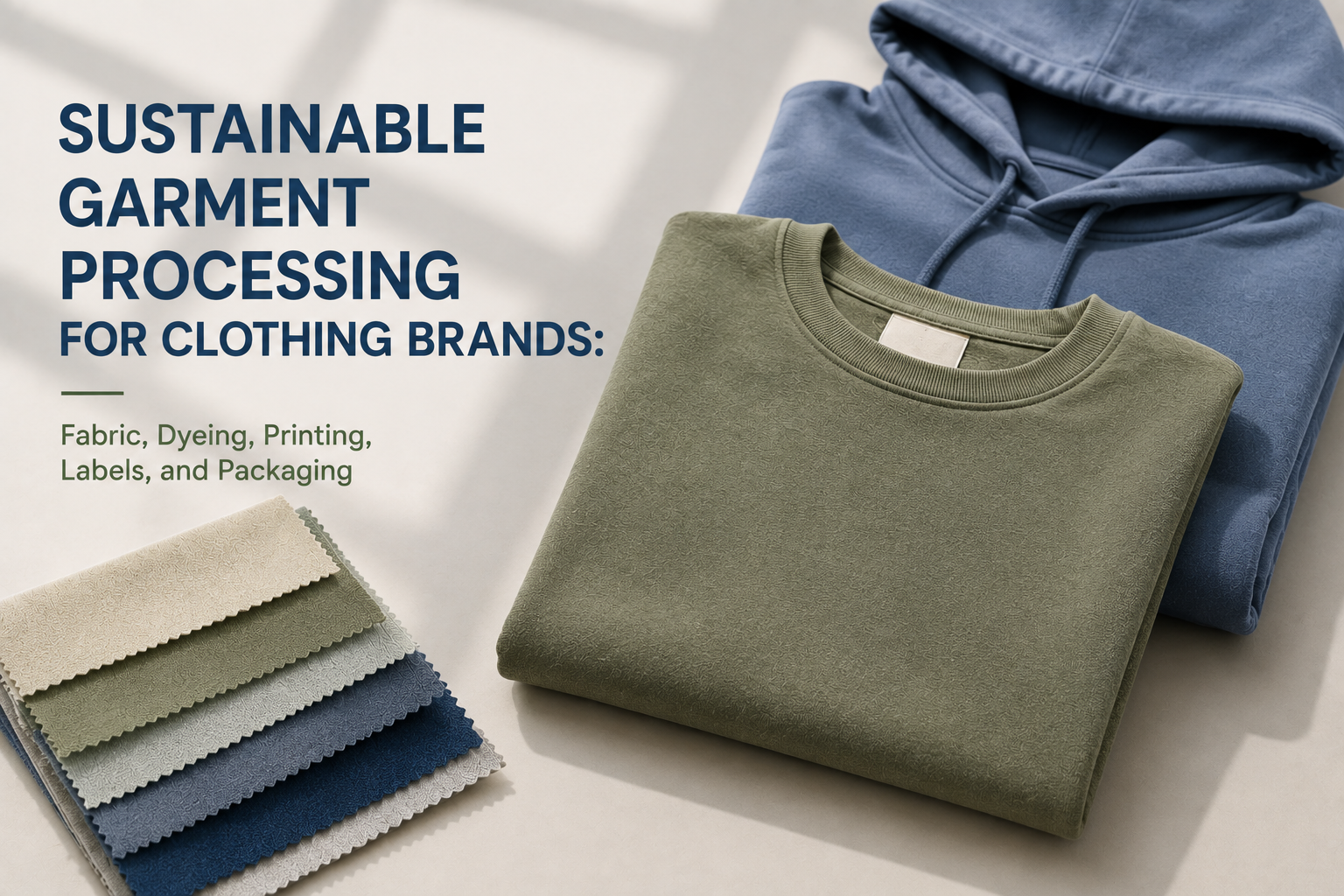
For a broader view of documentation and production stages, read sustainable garment processing.
How Do Labels and Packaging Show a Manufacturer’s Capability?
Labels and packaging show whether a factory understands brand-ready production instead of only sewing garments.
For many private-label brands, the garment itself is only one part of the finished product.
The manufacturer may also need to coordinate:
- heat transfer neck labels
- woven neck labels
- care labels
- hem tags
- side seam labels
- hang tags
- branded polybags
- paper packaging
- simple private-label packaging
For soft adult basics, label comfort matters.
A premium bamboo-cotton T-shirt can lose part of its comfort advantage if the neck label is stiff and irritating.
Likewise, a high-quality hoodie can still look unfinished if:
- the hang tag is poorly positioned
- the care label is oversized
- the woven label is crooked
- the packaging feels inconsistent
Labels also need to stay consistent across repeat orders.
Brands should confirm:
- dimensions
- colors
- folding method
- stitch position
- logo artwork
- material
- care wording
Packaging should match the product price level and distribution method.
An online startup may prefer simple protective packaging with clean branding. A mid-to-high-end basics brand may need a more developed packaging system.
The key is not making packaging complicated. It is making it consistent.
For more guidance on placement, read where should labels go in modern apparel.
How Can Brands Judge Fit and Quality Before Bulk Production?
A finished and washed sample is more useful than a fabric swatch because it shows how fabric, fit, construction, and branding perform together in the real garment.
Before approving bulk production, brands should check:
- fit after washing
- shrinkage
- neckline shape
- shoulder shape
- sleeve length
- body length
- side-seam twisting
- waistband comfort
- cuff recovery
- pocket placement
- stitching quality
- print or embroidery quality
- label comfort
- packaging presentation
For adult basics, small details often decide whether a product feels premium or low quality.
Consider a plain crewneck sweatshirt.
There may be no complicated design details, yet the product can still feel weak if:
- the collar stretches too easily
- the rib does not recover
- the shoulder shape looks wrong
- the body twists after washing
- the embroidery pulls the fabric
- the cuffs are too loose
The same principle applies to T-shirts.
A good T-shirt should still be reviewed for:
- neck rib recovery
- shoulder stability
- side-seam control
- hem appearance
- post-wash measurements
Brands should also define measurement tolerance before bulk production. The factory and buyer need the same standard when checking finished goods.
Approving a sample is not simply saying:
“Looks good.”
It means confirming that the approved garment becomes the production reference.
What Mistakes Should Brands Avoid When Choosing a Manufacturer?
The most common sourcing mistakes come from choosing by price alone, approving too little information, and making important product decisions too late.
Brands should avoid:
- choosing only by the lowest price
- choosing fabric only by fiber name
- developing too many SKUs in the first order
- ignoring GSM
- ignoring shrinkage testing
- not confirming size tolerance
- approving only a swatch instead of a finished sample
- preparing labels too late
- changing artwork after sample approval
- not confirming the production timeline before launch
- using unsupported sustainability claims
One common problem is asking several manufacturers for quotes without giving them the same specification.
Factory A may quote 180 GSM jersey.
Factory B may quote 220 GSM jersey.
Factory C may quote a different fiber blend.
The cheapest quotation is not necessarily cheaper when the products being quoted are different.
A better comparison gives every manufacturer the same:
- fabric composition
- GSM
- size range
- decoration
- labels
- packaging
- quantity
Then the brand can compare the quotations more fairly.
Another mistake is making major changes after the sample has been approved.
Changing:
- color
- artwork
- fabric
- packaging
- size specifications
late in development can affect both cost and timing.
For sustainable adult basics, practical production control matters just as much as choosing the right material.
How Can Hempspring Support Adult Basics Development?
Hempspring supports overseas brands developing repeatable adult basics through fabric sourcing, sampling, fit adjustment, branding, packaging, and OEM/ODM production planning.
The main product direction includes:
- custom T-shirts
- long sleeve tops
- tank tops
- hoodies
- sweatshirts
- joggers
- simple lounge sets
- basic shirts
Practical fabric options may include:
- bamboo cotton
- organic cotton
- cotton spandex
- cotton modal
- French terry
- brushed fleece
- rib
- jersey
- waffle
- selected premium blends when suitable
Development support may include:
- fabric sourcing
- GSM suggestions
- sample development
- fit adjustment
- printing
- embroidery
- custom labels
- custom packaging
- OEM/ODM production
At Taian Lianchuang Textile Co., Ltd., the focus for these projects is increasingly on adult basics that can be developed clearly and repeated consistently rather than highly complex, multi-layer garments.
This can support:
- startups developing their first collection
- growing brands adding new basics
- mature brands looking for a second supplier
- overseas brands in the US, Australia, Europe, the Middle East, and South America
A useful first inquiry usually includes:
- reference images
- product type
- preferred fabric
- target GSM
- size range
- expected quantity
- logo or decoration
- label requirements
- packaging
- target launch date
- destination market
The more clearly these points are defined, the more useful the first quotation and sample discussion can become.
Conclusion
Choosing a sustainable clothing manufacturer for adult basics is not only about price. Brands should compare product experience, fabric sourcing, MOQ, sample time, quality control, labels, packaging, documentation, and repeat-production stability. For commercial basics, bamboo cotton, organic cotton, cotton spandex, rib, jersey, French terry, and fleece are practical starting points. Brands planning custom development can share reference images, preferred fabric, GSM, size range, labels, quantities, and launch timing to make manufacturer evaluation and sampling more efficient.