As a sourcing director for an established apparel brand, you already know the 2026 market is shifting massively toward "Eco-Minimalism." Consumers in the US, Australia, and Europe no longer buy separate wardrobes for sleeping, lounging, and remote work. They want seasonless, multi-functional luxury. Mature brands are aggressively seeking reliable OEM partners who can deliver premium, eco-friendly knitted loungewear at scale without compromising on quality or missing critical delivery windows.
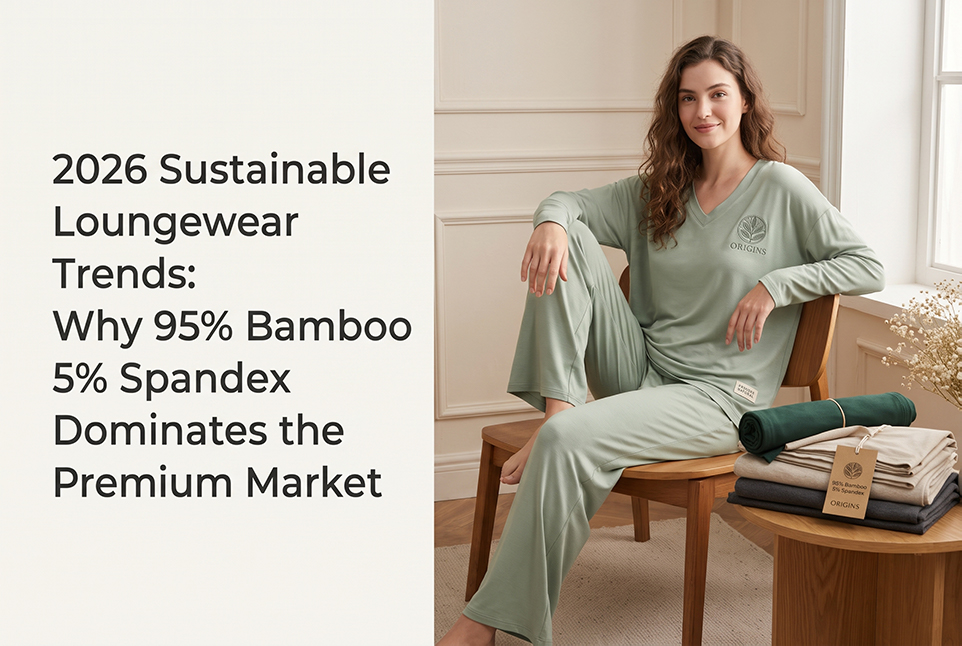
The 2026 sustainable loungewear market is dominated by seasonless, multi-functional garments engineered from high-end natural fibers. Premium brands are replacing cheap synthetic sleepwear with eco-luxe blends, specifically 95% bamboo and 5% spandex. To meet this massive consumer demand in Western markets, established apparel brands must partner with high-volume, B2B custom OEM manufacturers who possess stable bulk capacity, strict quality control standard operating procedures (SOPs), and verifiable eco-friendly textile certifications.
Sourcing premium fabric at scale is entirely different from buying a few yards for a test run. Let’s grab a coffee and look at exactly why this specific bamboo blend is taking over the market, and how a professional factory handles large-scale production without dropping the ball.
1. The Rise of Seasonless Eco-Luxe Loungewear
The line between what we wear to bed and what we wear to the grocery store has completely vanished. Buyers are actively abandoning cheap polyester sets that trap heat, pill after one wash, and look sloppy outside the house.
Seasonless eco-luxe loungewear represents a major shift in consumer buying habits, demanding elevated basics that seamlessly transition from sleepwear to streetwear. Premium apparel buyers now require high-end natural fibers that offer superior drape, exceptional temperature regulation, and long-term durability. By sourcing sustainable materials, established brands can command higher retail prices while building intense customer loyalty through unmatched garment longevity.
I talk to large-scale brand directors every week, and they all share the exact same headache. Their customers are complaining that traditional loungewear looks too messy for a quick video call or a coffee run. In 2026, versatility is the ultimate luxury. Your customers want to wake up, answer emails, and walk the dog without ever changing their clothes. This demand means the fabric has to do some heavy lifting.
Cheap synthetics are completely dead in the premium market. They feel sticky, they trap body odors, and they look incredibly cheap under natural light. Instead, mature brands are demanding heavy-drape natural knits. When you use premium sustainable materials, the garment moves beautifully over the human body. It regulates temperature organically, keeping the wearer cool in the summer and warm in the winter.
But producing this flawless look at a high volume is incredibly tough. You need a factory that understands how to cut and sew luxury knitwear without stretching out the seams. We engineer these elevated basics so they maintain their crisp, tailored look, ensuring your end-consumers feel appropriately dressed whether they are lounging on a couch or boarding a long-haul flight.
2. The Golden Ratio: Decoding the 95% Bamboo 5% Spandex Blend
Not all bamboo fabrics are created equal. If you use 100% bamboo viscose, the garment will completely lose its shape by noon. You need precise, calculated textile science to make it work on a commercial scale.
The 95% bamboo and 5% spandex blend is the textile industry’s golden ratio for premium loungewear. The 95% bamboo viscose provides an ultra-soft, silk-like hand feel, maximum breathability, and natural moisture-wicking properties. Meanwhile, the critical 5% spandex ensures structural shape retention and high stretch recovery, preventing the garment from bagging out at the knees or elbows after extended wear and multiple washing cycles.
Let me take you onto the cutting room floor for a second. We test hundreds of fabric rolls every single month, and I can tell you firsthand that the 95/5 bamboo-spandex blend is a masterpiece of textile engineering. Bamboo is incredible—it’s naturally hypoallergenic, absorbs moisture twice as fast as standard cotton, and has a luxurious, heavy drape that mimics pure silk.
But bamboo fiber has a fatal flaw: it lacks natural elasticity. If you manufacture a purely bamboo lounge pant, the knees will sag permanently after just a few hours of wear. That is a guaranteed customer return, and at high volumes, returns will destroy your profit margin. By integrating precisely 5% premium spandex during the knitting process, we create an invisible skeleton within the fabric itself. This spandex core provides explosive stretch recovery. It snaps the garment right back to your original Tech Pack measurements, wash after wash.
| Fiber Component | Percentage | Key Performance Function |
|---|---|---|
| Bamboo Viscose | 95% | Unmatched softness, moisture-wicking, thermal regulation. |
| Premium Spandex | 5% | Tensile strength, shape retention, structural recovery. |
When you are placing a massive bulk order for thousands of units, this specific textile formula guarantees absolute consistency. Your size medium will always fit exactly like a size medium, protecting your brand’s hard-earned reputation.
3. Certifications Matter: Ensuring Compliance for Global Markets
You can’t just slap a green "eco-friendly" tag on a garment and export it to the EU or the US anymore. Customs agents will seize your container, and your own customers will expose you online for greenwashing.
For mature apparel brands exporting to North America, Europe, and Australia, verifiable eco-friendly textile certifications are strictly non-negotiable. Partnering with an OEM manufacturer that utilizes GOTS (Global Organic Textile Standard) certified organic materials and OEKO-TEX Standard 100 certified non-toxic dyes ensures absolute supply chain transparency. These global certifications guarantee that the loungewear is free from harmful chemicals, passing strict customs regulations and building deep consumer trust.
I hear the absolute frustration from sourcing directors all the time: "My last supplier sent me a fake GOTS certificate, and my shipment got held up at the border for three weeks." It’s a complete nightmare that can cost you an entire peak selling season.
In 2026, if you are ordering high-volume production, you need bulletproof compliance. When we source raw materials, we demand full traceability from the yarn to the dye house. OEKO-TEX Standard 100 isn’t just a nice sticker to put on your packaging; it means every single thread, button, and dye batch has been scientifically lab-tested for harmful substances. It means your loungewear is perfectly safe to be worn directly against bare skin for twelve hours a day.
True, verifiable compliance auditing is baked into our daily factory operations. We maintain these rigorous standards across massive bulk production runs, so you never have to worry about legal liabilities or PR disasters when your cargo container finally lands in Los Angeles or Sydney.
4. Scaling Up: Quality Control in Premium Loungewear Production
Making one perfect sample is easy. Making ten thousand perfect units, shipped on time and exactly to spec, is where amateur factories fail and professional OEM partners shine.
Scaling premium loungewear production requires rigorous, standardized Quality Control (QC) protocols across the entire bulk manufacturing process. High-volume B2B apparel production demands strict dimensional stability testing to control fabric shrinkage, advanced colorfastness lab tests to prevent dye bleeding, and flawless flatlock stitching techniques. Implementing a stringent factory SOP guarantees uniform consistency and defect-free garments across thousands of exported units.
When you place a massive bulk order, you are putting your career on the line. You need a factory that treats your production with militant precision. Let’s talk about shrinkage. Bamboo blends love to shrink if they aren’t processed correctly. Before we even unroll the fabric for cutting, we run industrial wash tests to lock down the exact dimensional stability. We pre-shrink the fabric so that your customers don’t experience warped side seams after laundry day.
Next is colorfastness. We rigorously test our eco-friendly dyes to ensure that your deep navy loungewear sets don’t bleed onto your customer’s expensive white bedsheets. Finally, the sewing itself requires true mastery. Bamboo jersey is notoriously slippery on the sewing machine. Our seasoned machinists use specialized flatlock stitching that lies completely flat against the skin, eliminating chafing and elevating the luxury feel.
Whether your brand is developing a line of premium daywear or you are searching for a highly reliable custom pajama manufacturer to produce high-end sleepwear collections at scale, you need standardized SOPs. Our rigorous [quality assurance](2026 Sustainable Loungewear Trends: Why 95% Bamboo 5% Spandex Dominates the Premium Market) ensures that the ten-thousandth unit looks identically flawless to the approved pre-production sample.
Conclusion
Superior fabric and unwavering manufacturing capacity are the ultimate lifelines of any mature apparel brand. Don’t risk your brand’s reputation on inconsistent suppliers who cannot handle high-volume quality control. If you are ready to upgrade your supply chain for 2026, contact our production team today to request physical fabric swatches, schedule a factory audit, or send your Tech Packs for an accurate bulk production quotation.