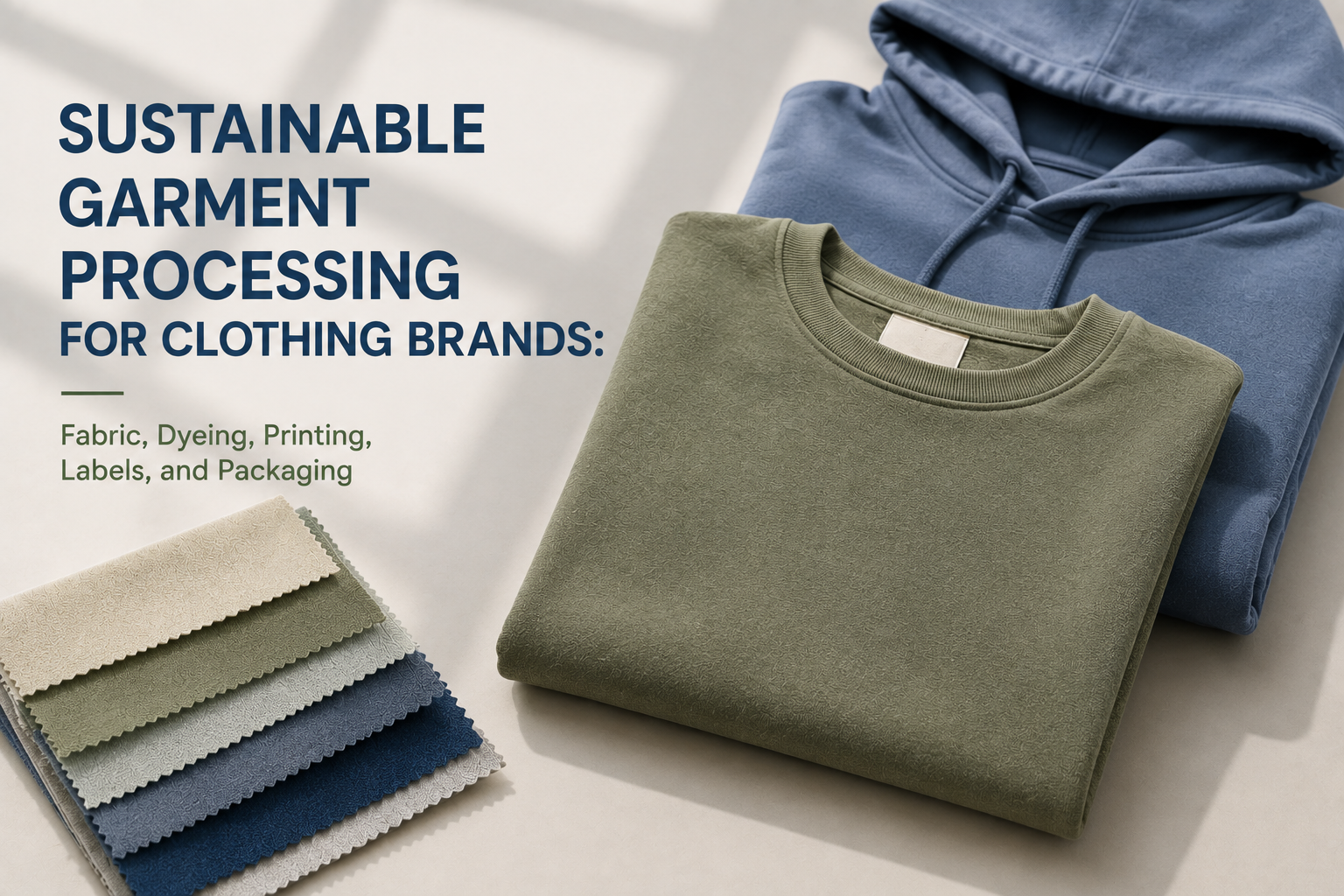
French terry lounge sets are a practical product for comfort-focused brands because they can work across loungewear, travel clothing, athleisure, and relaxed everyday outfits. However, buyers should confirm fabric weight, fit, shrinkage, decoration, trims, labels, packaging, and production timing before sampling. A matching set may look simple, but small technical decisions strongly affect comfort and bulk quality.
Brands should confirm fabric composition, GSM, shrinkage, fit, size chart, and the exact top-and-bottom structure before sampling French terry lounge sets. They should also define whether the top is a sweatshirt, pullover hoodie, zip hoodie, or cropped style, and whether the bottom is a jogger, straight-leg pant, wide-leg pant, or short. Rib, waistband elastic, drawcords, pockets, print or embroidery, labels, packaging, MOQ, sample time, and bulk production timing should all be discussed before the first sample is approved.
This guide covers French terry fabric, product structure, fabric weight, fit details, decoration, label options, and how brands can work with a manufacturer before sampling.
Why Are French Terry Lounge Sets Popular for Apparel Brands?
French terry lounge sets are popular because they combine comfort, casual styling, and everyday wearability without feeling as heavy as many brushed fleece products.
A French terry lounge set normally combines a top and bottom made from the same fabric, color, or design direction. Common combinations include a crewneck sweatshirt with joggers, a hoodie with lounge pants, or a cropped top with wide-leg pants.
For apparel brands, a matching set has several practical advantages.
It is easy for customers to understand. The pieces can be sold together or separately, which gives the brand more pricing and merchandising flexibility. A complete set is also easier to photograph and present as a clear hero product during a new launch.
French terry lounge sets can work for:
- loungewear
- athleisure
- travel clothing
- work-from-home outfits
- relaxed daily wear
- premium basics
- transitional-season collections
French terry is often more breathable than heavy brushed fleece, making it useful for spring, autumn, mild winter, and indoor-to-outdoor lifestyles.
Comfort clothing in 2026 is not limited to homewear. Many brands are developing pieces that can be worn during travel, while working remotely, or as relaxed everyday outfits. This makes a clean, well-fitted lounge set more commercially useful than a product designed only for sleeping or staying at home.
For startup founders planning a wider comfort collection, this guide on building a sustainable loungewear brand provides useful product and manufacturing context.
What Is French Terry Fabric for Lounge Sets?
French terry is a knitted fabric with a smooth outer face and a looped inner surface, commonly used for sweatshirts, hoodies, joggers, shorts, and matching sets.
The looped inside is the main feature that separates regular French terry from brushed fleece. The outer face is usually smooth enough for printing, embroidery, and clean everyday styling, while the inner loops provide softness without creating a heavily brushed winter surface.
French terry can be produced in different weights and compositions. Common options include:
- organic cotton French terry
- cotton-spandex French terry
- hemp-cotton French terry
- bamboo-cotton French terry
- cotton-modal French terry
- cotton-polyester or recycled blended French terry
The same fabric name can describe very different results. A 250 GSM cotton French terry may feel light and relaxed, while a 380 GSM hemp-cotton version may feel structured and substantial.
Fabric performance also depends on:
- yarn quality
- knitting density
- fiber blend
- washing treatment
- finishing
- shrinkage control
Brands should therefore request the full fabric specification rather than asking only for “French terry.”
If your team is deciding whether French terry or fleece better suits a collection, read French Terry sweatshirt vs fleece.
French Terry vs Fleece: Which Is Better for Lounge Sets?
French terry is usually better for breathable everyday lounge sets, while brushed fleece is generally better for warmer winter sets and cozy cold-weather products.
Neither fabric is always better. The correct choice depends on the target season, market, product positioning, GSM, and fiber composition.
| Fabric | Warmth | Breathability | Best Product Use | Decoration Suitability | Target Season |
|---|---|---|---|---|---|
| French terry | Medium | High | Sweatshirts, joggers, travel sets, daily loungewear | Printing and embroidery | Spring, autumn, mild winter |
| Brushed fleece | High | Medium | Winter hoodies, warm joggers, cozy matching sets | Embroidery, printing, appliqué | Late autumn and winter |
| Lightweight jersey | Low | High | Soft tops, shorts, summer lounge sets | Printing and light embroidery | Spring and summer |
| Rib fabric | Low to medium | Medium to high | Fitted tops, tanks, cuffs, waistbands | Small logos and labels | Multi-season |
French terry is commonly selected for brands that want one lounge set to work across several situations. It can be worn indoors but still feel appropriate for travel or casual outdoor use.
Brushed fleece creates a warmer and softer inside feel. It is usually better for winter products, holiday sets, and cold-market collections.
However, fabric name alone is not enough. A heavy French terry can feel warmer than a very lightweight fleece. Brands should compare real fabric samples using the same composition, GSM range, and wash conditions whenever possible.
For a more detailed hoodie and sweatshirt comparison, see French Terry vs Brushed Fleece.
What Products Can Be Included in a French Terry Lounge Set?
A French terry lounge set can combine sweatshirts, hoodies, joggers, wide-leg pants, straight-leg pants, shorts, or relaxed tops, depending on the customer and season.
Common set combinations include:
- crewneck sweatshirt and jogger
- pullover hoodie and jogger
- zip hoodie and lounge pants
- cropped sweatshirt and wide-leg pants
- long sleeve top and lounge shorts
- relaxed sweatshirt and straight-leg pants
- oversized sweatshirt and drawstring sweatpants
- hoodie and shorts for transitional seasons
The right combination depends on the target customer.
A classic sweatshirt-and-jogger set is easy to understand and works well for basics brands. A cropped sweatshirt with wide-leg pants may suit a women’s comfort or influencer-led collection. A zip hoodie with straight-leg pants may work better for travel clothing or premium casualwear.
Brands should also think about the sales channel.
For online launches, a simple matching set is easier to photograph and explain. For distributors or multi-category brands, separate tops and bottoms may provide more flexible ordering and size combinations.
Startup brands should usually begin with one strong set instead of developing too many silhouettes in the first order. One well-tested set is easier to fit, grade, photograph, and reorder.
Brands planning bottom styles can review available custom joggers, while hoodie-led sets can connect naturally with custom hoodies.
What GSM Should Brands Choose for French Terry Lounge Sets?
Most regular French terry lounge sets use midweight fabric, but the correct GSM depends on season, market, silhouette, price point, and intended use.
A practical reference is:
| GSM Range | Typical Use |
|---|---|
| 240–280 GSM | Lightweight indoor lounge sets, spring or autumn tops, warmer markets |
| 280–340 GSM | Regular French terry sweatshirts and jogger sets |
| 340–380 GSM | Heavier premium lounge sets and Fall/Winter basics |
| 380+ GSM | Heavy hoodie and jogger sets for colder markets or structured silhouettes |
A lighter fabric may work well for indoor use or warm regions, but it may feel too thin for a premium jogger. A heavier fabric can create structure and perceived quality, but it also increases shipping weight and may feel too warm for some customers.
The top and bottom do not always need identical performance.
For example, a sweatshirt may look good in a soft midweight French terry, while the pants may need better recovery and more stability around the knees and seat. Some brands still use the same fabric for a visually consistent set, but they should test whether it performs well in both garments.
GSM should be considered together with:
- fiber composition
- knitting density
- fit
- stretch and recovery
- shrinkage
- decoration method
- freight cost
For broader fabric-weight planning, read GSM for long sleeve T-shirts, crewneck sweatshirts, and joggers.
What Fabric Composition Should Brands Compare?
Brands should compare French terry compositions based on softness, structure, stretch, sustainability requirements, cost, and repeat-production stability.
Organic cotton French terry
Organic cotton French terry works well for natural premium basics. It provides a familiar cotton feel and can be used for sweatshirts, hoodies, and joggers.
Brands that require certification should confirm the scope, validity, supplier details, and whether the relevant material or production stage is covered.
Cotton-spandex French terry
A small amount of spandex can improve stretch and recovery. This may be useful for more fitted joggers, waistbands, cuffs, or lounge pants that need better movement.
Too much stretch can change the hand feel and make production control more difficult, so recovery should be tested after washing.
Hemp-cotton French terry
Hemp-cotton blends can add natural texture and a stronger material story. They may suit sustainable basics, relaxed lounge sets, and brands looking for an alternative to standard cotton-only collections.
The final softness and shrinkage should be checked in a finished sample.
Bamboo-cotton French terry
Bamboo-derived and cotton blends may create a softer, more drapey result. The exact bamboo fiber description and processing route should be confirmed before brands make sustainability claims.
Cotton-modal French terry
Modal blends can feel smoother and softer, which may suit comfort-led loungewear. Brands should test pilling, shrinkage, and recovery carefully.
Cotton-polyester or recycled blends
Synthetic or recycled blends may be practical when durability, shape retention, cost, or faster drying is important. However, they may not match every sustainable brand’s preferred material strategy.
The most unusual blend is not automatically the best commercial option. Brands need a fabric that can be repeated consistently, fits the target price, and performs after washing.
For a broader sourcing comparison, see best sustainable fabrics for clothing brands.
What Fit and Construction Details Should Brands Confirm?
Brands should confirm the complete top and bottom silhouette, measurements, rib details, waistband structure, pockets, and post-wash fit before approving a lounge set.
A French terry lounge set may look simple, but the comfort and quality depend heavily on construction.
Fit and construction checklist
- top silhouette: crewneck, hoodie, zip hoodie, cropped, oversized, or relaxed
- bottom silhouette: jogger, wide-leg pant, straight-leg pant, or shorts
- size range
- size chart
- top length
- sleeve length
- shoulder shape
- waistband height
- waistband elastic quality
- drawcord type
- pocket structure
- cuff and hem rib
- rib recovery
- seam finish
- shrinkage allowance
- fit after washing
For the top, the brand should decide whether it wants dropped shoulders, a regular shoulder, or a more fitted shape. Hood depth, neckline shape, body length, and cuff tension also affect the final look.
For bottoms, the waistband is one of the most important areas. Weak elastic can twist or lose recovery. A poor drawcord opening can look unfinished. Pockets may also add bulk or change the side seam shape.
Rib quality should match the body fabric in color, stretch, and recovery. If the rib shrinks differently from the main fabric, cuffs and waistbands may distort after washing.
The brand should evaluate the complete set on a body and after washing, not only on a flat table.
What Printing, Embroidery, and Branding Options Work for French Terry Lounge Sets?
French terry usually supports many decoration methods, but brands should test each method on the final fabric weight and surface before bulk production.
Common decoration options include:
- small chest logo
- tonal embroidery
- large back print
- water-based print
- screen print
- puff print
- appliqué embroidery
- woven patch
- hem tag
- heat transfer neck label
- hang tag
- branded packaging
A smooth outer surface is normally easier for clean screen printing and detailed graphics. Heavier French terry can often support embroidery well, but dense embroidery may pull or distort lighter fabric.
Tonal embroidery works well for premium, quiet branding. Large back prints can support streetwear or influencer-led collections. Puff print and appliqué can add depth, but they should be tested for wash durability and fabric compatibility.
Decoration placement also affects how the set looks together. A large logo on both garments may feel excessive, while a chest logo on the top and a small leg logo on the jogger can create a more balanced system.
Labels should be comfortable and consistent with the brand position. For placement planning, see where should labels go in modern apparel.
What Should Brands Confirm Before Sampling French Terry Lounge Sets?
Before sampling, brands should confirm the product combination, fabric, fit, trims, decoration, labels, packaging, quantity expectations, and target launch date.
Use this practical checklist:
- product combination
- fabric composition
- GSM
- color plan
- shrinkage rate
- fit reference
- size range
- sweatshirt or hoodie details
- jogger or pant details
- waistband and drawcord
- rib quality
- pockets
- print or embroidery method
- label placement
- care label wording
- packaging
- MOQ
- sample time
- revision time
- bulk production timeline
- target launch date
- shipping destination
Reference images are useful, but they should be supported by written requirements. A factory cannot know whether the brand wants a soft oversized set, a structured streetwear set, or a fitted travel set from one image alone.
Brands should not approve only a fabric swatch. A finished sample after washing is more useful because it shows:
- shrinkage
- rib recovery
- fit
- seam comfort
- waistband performance
- final product appearance
Sampling time can also change when brands need custom-dyed fabric, uncommon blends, special decoration, several revisions, or certification documents. For material and production timing, read hemp, bamboo, and organic cotton production lead times.
How Can Hempspring Help Brands Develop French Terry Lounge Sets?
Hempspring can support brands with fabric sourcing, GSM planning, sampling, fit adjustment, decoration, labels, packaging, and OEM/ODM production for matching lounge sets.
Available development directions may include:
- organic cotton French terry
- hemp-cotton French terry
- bamboo-cotton French terry
- modal-cotton blends
- sweatshirts
- hoodies
- joggers
- lounge pants
- shorts
- matching sets
Support can include:
- fabric sourcing
- GSM suggestions
- sample development
- fit adjustment
- printing and embroidery
- custom labels
- hang tags
- custom packaging
- OEM/ODM production
This can support startup and growing brands developing their first lounge collection, as well as mature apparel brands looking for an additional supplier.
Hempspring works with overseas brands in the United States, Australia, Europe, the Middle East, and South America. The practical starting point is usually a clear product combination, target fabric weight, fit reference, expected quantity, and launch schedule.
The aim is not to make the lounge set more complicated. It is to make each decision clear enough that the first sample provides useful information for the next step.
Conclusion
French terry lounge sets are practical for brands developing comfort apparel, athleisure basics, travel outfits, and premium matching sets. The final result depends on fabric composition, GSM, fit, shrinkage, trims, decoration, labels, packaging, and sample testing. Brands planning custom development can share reference images, fabric preferences, GSM targets, set combinations, expected quantities, and launch schedules to make the first sampling discussion clearer and more efficient.