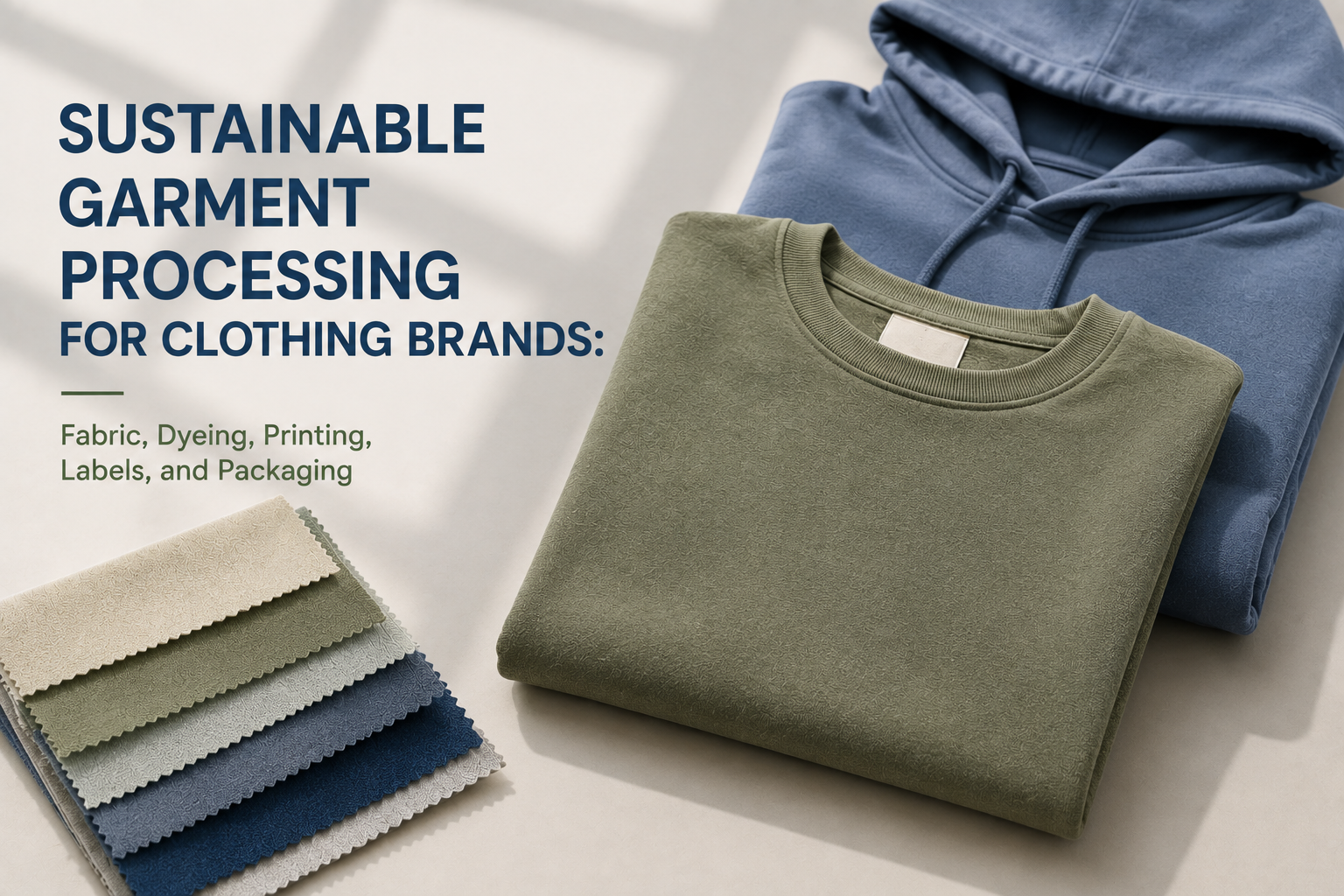
Hey there, I am so glad you stopped by today. Grab a cup of coffee and let’s talk about the physical products that actually build a profitable clothing brand. Marketing is fantastic, but if the clothes don’t fit perfectly and feel amazing, your customers will never come back. I spend my days on the factory floor at Taian Lianchuang Textile, and I want to show you exactly how we build adult clothing that people love to wear.
To build a highly profitable custom B2B adult clothing line, brand purchasers must focus on the physical construction and specific organic knit fabrics of their garments. Perfecting core products like heavy-weight organic cotton hoodies, structured sweatpants, pre-shrunk casual T-shirts, and 95% bamboo 5% spandex pajamas guarantees repeat customers. By partnering with a manufacturer that understands fabric memory, precise stitching techniques, and exact material blends, you eliminate sizing errors and create loungewear that truly stands out in the North American and European markets.
Let’s get out of the spreadsheets for a minute and get our hands on the fabric. We are going to break down the exact anatomy of the best-selling adult organic garments, piece by piece.
What Makes a Custom Organic Cotton Hoodie Stand Out in the Adult Market?
Have you ever put on a hoodie and felt like it was just swallowing you in all the wrong ways? The shoulders are pointy, the hood is flimsy, and the fabric feels like cardboard. That happens when factories cut corners. Let’s talk about how to build a hoodie the right way.
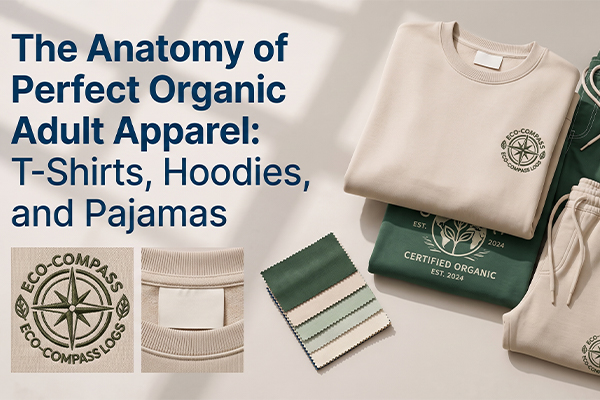
A standout custom adult hoodie requires premium organic cotton knits, such as French Terry or brushed fleece, weighing between 280gsm and 350gsm for optimal drape. A quality B2B manufacturer ensures the hood is double-lined for structural integrity and uses flatlock stitching to prevent bulky, uncomfortable interior seams. By focusing on these specific construction details and avoiding cheap, lightweight fabrics, brands can offer a superior, durable product that justifies a healthy profit margin in competitive retail markets.
I was talking with a brand purchaser from Australia a few weeks ago. He was frustrated because his previous supplier had sent him a batch of adult hoodies that looked like deflated balloons after one wash. The fabric was thin, the cuffs had lost all their elasticity, and the hood literally flopped around like a wet towel. He asked me, "How do I fix this? I want a hoodie that feels like armor, but soft."
The secret always starts with the weight and the structure of the knit.
The Battle of the Weights: French Terry vs. Fleece
When you are designing custom organic hoodies, you have two primary choices for the interior knit: French Terry or Brushed Fleece.
Organic cotton French Terry is brilliant because the inside is made of tiny, uncut loops of yarn. These loops naturally absorb moisture and allow air to circulate. If your target market wants a hoodie they can wear on a cool summer evening or while warming up at the gym, a 280gsm (grams per square meter) French Terry is your best friend. It drapes beautifully over the shoulders without looking stiff.
On the other hand, if you are selling into a cold European or North American winter, you need Brushed Fleece. We take that same organic cotton, but we run it through a machine that physically brushes the loops until they explode into a soft, fuzzy layer. This traps body heat. A 350gsm organic brushed fleece hoodie feels like wearing a warm hug. It is substantial, heavy, and makes the wearer feel incredibly secure.
Anatomy of a Perfect Hood
Here is a detail that most buyers completely miss: the hood construction. A cheap hoodie uses a single layer of fabric for the hood. When the customer wears it down, it looks messy and exposes the ugly interior seams.
We always recommend a double-lined hood. We take two layers of the main body fabric and sew them together. This hides all the interior seams and gives the hood the physical weight it needs to lay perfectly flat against the upper back. When the customer pulls the hood up, it holds its shape around their face perfectly.
The Stitching That Holds It Together
Let’s talk about the seams. Have you ever worn a sweatshirt where the seam under the armpit is so thick it literally chafes your skin?
That is caused by standard overlock stitching. To prevent this, we utilize advanced stitching techniques like cover-stitching or flatlock stitching on critical stress points. This presses the seam flat against the body. Not only does it make the garment infinitely more comfortable, but it also gives the outside of the hoodie a beautifully constructed, architectural look.
| Feature | Cheap Blank Hoodie | Custom Organic Hoodie |
|---|---|---|
| Hood Construction | Single-ply, floppy | Double-lined, structured |
| Fabric Weight | 180-220gsm (Thin) | 280-350gsm (Substantial) |
| Seams | Standard overlock (Bulky) | Flatlock / Cover-stitched |
| Drawstrings | Frayed ends | Custom metal aglets |
When you pay attention to the physical product, your marketing becomes so much easier. You aren’t just selling a picture; you are selling an experience that the customer can literally feel the moment they open the box.
How Do You Design Custom Sweatpants That Never Lose Their Shape?
Sweatpants used to be the clothes you wore when you gave up for the day. Now, they are a daily uniform. But there is a massive problem in the loungewear industry: the dreaded "baggy knee." Let’s fix it.
Designing custom organic sweatpants that retain their shape requires heavy-weight knit fabrics with natural memory and reinforced ribbed cuffs. A professional manufacturer will match the exact dye lot and fabric weight of your hoodies to create seamless lounge sets. By engineering a deep pocket design to prevent phones from falling out and utilizing a fully encased elastic waistband, you provide a durable, stylish jogger that adults can wear from the couch directly to the street.
I have a personal rule: if my phone falls out of my sweatpants when I sit in my car, I throw the pants away. It is infuriating, isn’t it?
I had a client from Europe—a fantastic guy who had built a massive following on social media. He launched a line of casual joggers, and they sold out in a week. But a month later, the emails started pouring in. His customers were complaining that after sitting at their desks for a few hours, the knees of the sweatpants were permanently stretched out, making them look completely sloppy.
He was panicked. He thought his whole business was going to collapse. We had to sit down and completely re-engineer his product from the ground up.
Solving the Baggy Knee Syndrome
Why do knees bag out? It happens when a brand tries to save money by using a loose, cheap knit structure with short cotton fibers. When you bend your knee, you stretch the fabric. If the cotton fibers are short and weak, they break and stretch, permanently warping the shape of the leg.
The solution is using premium, long-staple organic cotton knitted at a high density. When the knit is tight and the fibers are long, the fabric has natural "memory." When the customer stands up, the fabric snaps right back into a straight line.
If you are designing a slimmer fit jogger, we often recommend blending a tiny amount of spandex into the organic cotton. This guarantees that the pants move with the body during a morning walk, but maintain their crisp silhouette for an afternoon coffee run.
The Perfect Waistband and Cuffs
The waistband is the anchor of the garment. Never let a factory stitch raw elastic directly against the skin. It is scratchy and looks terrible. We construct our waistbands by fully encasing a wide, heavy-duty elastic band inside the organic cotton fabric, and then we run three to four lines of horizontal stitching through the entire band.
This multi-needle stitching does two things: it looks incredibly professional, and it strictly prevents the elastic from twisting or rolling over inside the fabric when the pants are washed.
For the ankle cuffs, you must use a dense 2×2 or 1×1 rib knit. The cuff needs to grip the ankle gently without cutting off circulation. If the cuff is just made of the regular body fabric gathered with a piece of cheap elastic, it will look like a pair of pajama pants from the 1980s.
Designing for Real Life
Remember the phone problem I mentioned earlier? When you design a custom organic lounge set, you are designing for real, everyday adult life.
We engineer the pockets on our sweatpants to be at least 6.5 inches deep with a slight forward angle. This means when your customer sits down in their car or on the subway, their heavy smartphone slides toward the front of their thigh, safely secured, instead of slipping out onto the floor.
It is these tiny, obsessive physical details that turn a one-time buyer into a lifelong brand advocate. When your matching hoodie and sweatpant sets look flawless and function perfectly, your customers will naturally want to buy them in every single color.
Why Are 95% Bamboo 5% Spandex Adult Pajamas the Best Choice for Sleepwear?
Adult sleepwear is exploding right now. People are stressed, and they want their bed to feel like a sanctuary. But if you choose the wrong fabric, you are going to make your customers miserable. Let’s talk about the actual science of sleepwear.
The absolute best material for custom adult sleepwear is exactly 95% bamboo and 5% spandex because it uniquely balances moisture-wicking properties with precise stretch recovery. While 100% bamboo jersey loses its shape completely during sleep, adding 5% spandex ensures the pajamas stretch with the body’s natural nighttime movements and snap back to their original fit by morning. This specific blend is exceptionally breathable, buttery soft, and perfect for adults who struggle with night sweats.
I want to share a secret with you that a lot of marketing agencies don’t want you to know. There is a massive trend right now of brands advertising "100% Bamboo Stretch Pajamas."
It is scientifically impossible, and it drives me crazy.
A few years ago, a buyer came to me demanding 100% bamboo jersey for her new line of adult sleepwear. I tried to warn her. I told her that pure bamboo fiber is beautiful and soft, but it has zero mechanical elasticity. She insisted. We made the samples. She took them home to test, and she called me the next morning laughing at herself.
She told me, "I wore the pajama pants to bed. I roll around a lot in my sleep. When I woke up, the pants had stretched so much they were falling off my waist, and the legs were three inches longer."
The Magic of the 95/5 Formula
You cannot build functional sleepwear without stretch recovery. Period.
This is why, at Taian Lianchuang Textile, we strictly manufacture our premium pajamas using 95% bamboo and 5% spandex. We refuse to lie about the composition just to make the marketing sound a tiny bit more natural. Honesty makes a better product.
That 5% spandex is the hardest working fiber in the room. When your customer curls up into a ball, the fabric stretches around their knees and shoulders without feeling tight or restrictive. When they stretch out in the morning, the fabric instantly snaps back. The pajamas look exactly the same on day three as they did on day one.
The Ultimate Solution for Night Sweats
Adults sleep differently than kids. Many adults deal with temperature fluctuations, stress-induced night sweats, or hot flashes. This is where the 95% bamboo really shines.
Bamboo viscose is naturally porous. It is incredibly breathable and has a unique ability to pull moisture away from the skin and evaporate it into the air. If you sell traditional polyester pajamas, your customer is basically sleeping inside a plastic bag. They will wake up damp and cold.
When they sleep in our exact bamboo spandex blend, the fabric regulates their body temperature. It feels cool to the touch in the summer, yet provides a cozy, insulating layer in the winter.
Construction Details for Uninterrupted Sleep
When you are manufacturing clothing that rubs against someone’s skin for eight hours straight, you cannot make mistakes with the construction.
Here is what we do on the factory floor to make sure your pajamas get perfect reviews:
- Zero Woven Tags: We completely eliminate woven neck labels. A scratchy tag on the back of the neck will ruin a night’s sleep. We use soft, heat-transfer printed labels that the wearer cannot feel at all.
- Wrapped Waistbands: The elastic waistband is entirely wrapped in the ultra-soft bamboo fabric. The raw elastic never touches the skin.
- Flat Seams: We utilize flatlock seams on the shoulders and sides, ensuring there are no bulky thread ridges to press into the ribs when the customer sleeps on their side.
When you nail these product details, your customers won’t just like your pajamas; they will actively refuse to sleep in anything else.
What Is the Secret to a Perfect Custom Organic Knit T-Shirt?
The adult T-shirt is the ultimate staple. It is the blank canvas of the clothing world. But a terrible T-shirt can ruin a brand’s reputation instantly. You know exactly what I am talking about—the shirt that twists, shrinks, and chokes you at the collar. Let’s build a better one.
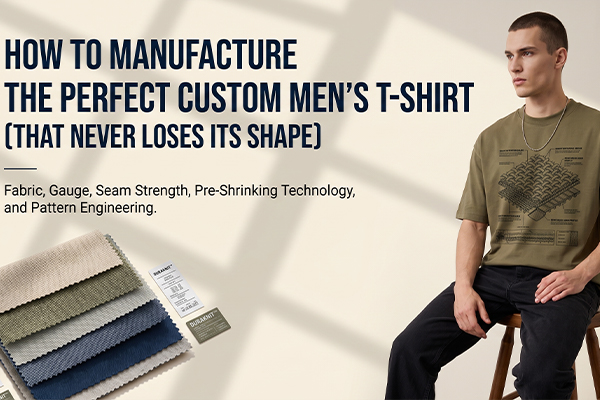
Creating the perfect custom adult T-shirt requires pre-shrunk organic cotton knits, reinforced shoulder-to-shoulder taping, and high-recovery ribbed neckbands. By pre-washing the fabric before cutting, the manufacturer entirely prevents side-seam twisting, ensuring the garment hangs straight. Utilizing heavier organic cotton or hemp blends (200gsm+) provides a premium, structured drape that doesn’t cling to the body, offering adult buyers a durable, everyday essential that maintains its exact fit wash after wash.
I absolutely love a good T-shirt. I probably have forty of them in my closet, but I only ever wear about four of them. Why? Because most T-shirts are built to be disposable.
I remember walking through a trade show and looking at racks of wholesale blank T-shirts. They looked nice on the hanger, but when I touched them, the fabric was paper-thin, and the collars were already stretching out. If you print your beautiful brand logo on a disposable T-shirt, your brand becomes disposable.
Stopping the Dreaded Side-Seam Twist
Let’s get a bit technical about why cheap T-shirts fail. Have you ever washed a shirt, put it on, and realized the side seam is twisting around to your belly button?
This is the hallmark of cheap manufacturing. Fabric is knitted in massive, continuous tubes. Factories that want to maximize profits will stretch the fabric tight and cut it immediately. But cotton is organic. It has a memory. When the customer takes that shirt home and puts it in the washing machine, the water causes the stressed yarns to relax and try to return to their original, untwisted state. The whole shirt warps.
At our facility, we respect the fabric. Before the scissors ever touch your organic cotton apparel, we wash it. We let the fabric relax and pre-shrink. We cut it exactly how it naturally wants to lay. It costs us a little more time, but it means your T-shirt will hang perfectly straight, even after fifty trips through the laundry.
The Anatomy of the Collar and Shoulders
The collar is the most important part of the T-shirt because it frames the wearer’s face. If the collar is wavy or stretched out, the whole outfit looks incredibly sloppy.
To build a premium collar, we don’t just fold the body fabric over. We use a dedicated 1×1 ribbed knit that is slightly heavier than the main body fabric. This ribbing has exceptional elasticity, meaning it can stretch over the head and immediately snap back tight against the collarbone.
Furthermore, we employ a technique called "shoulder-to-shoulder taping." If you turn a premium T-shirt inside out, you will see a continuous strip of fabric sewn across the back of the neck and down both shoulders. This taping acts as a structural bridge. It prevents the heavy weight of the sleeves from pulling and stretching the shoulder seams out of shape over time.
Choosing the Right Fabric Weight
Adult buyers are moving away from thin, clingy fabrics. They want substance.
If you are designing a casual everyday T-shirt, I highly recommend looking at an organic cotton weight of around 200gsm to 220gsm. It provides a confident, structured drape that skims over the body rather than clinging to every curve.
If your market is in a hot, humid climate like Australia or the southern United States, consider a blend of organic cotton and hemp. Hemp is incredibly durable, naturally anti-bacterial, and gets softer every single time you wash it.
When you stop buying off-the-shelf blanks and start truly designing the physical product, you elevate your brand from a simple merch store to a true fashion house.
Conclusion
Your brand’s success literally hangs on the quality of the fabric and the precision of the stitches. By engineering double-lined hoodies, shape-retaining sweatpants, perfectly blended 95% bamboo 5% spandex pajamas, and pre-shrunk T-shirts, you build a B2B product line that commands respect and guarantees massive customer loyalty.